Retrieval-augmented generation, internal knowledge bases and semantic search over your data.
Large language models do not know your internal documents and they do not stay up to date. This leads to generic or incorrect answers you cannot rely on in business.
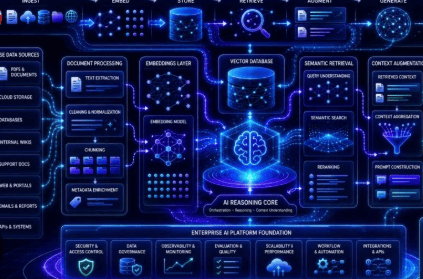
RAG combines retrieval and generation: the model first fetches the right passages from your own data and answers only from them, with citations. Answers are current, traceable and grounded in your own knowledge.
We deliver knowledge retrieval solutions from idea all the way to production. We start from the business goal, build a scoped version, measure the result and only then expand. This ensures the solution delivers measurable value rather than remaining an experiment.
We do not start from technology but from your goal. Before we write a line of code, we agree together what problem we are solving, who it benefits and how success is measured. This saves time and money, because we build only what delivers value.
A solution nobody can maintain is not a finished solution. That is why we document the work, train your team and build the system so it can be developed without us. Our goal is that knowledge retrieval keeps delivering value long after our engagement.
A concrete benefit the solution delivers for your business from the start.
A concrete benefit the solution delivers for your business from the start.
A concrete benefit the solution delivers for your business from the start.
A concrete benefit the solution delivers for your business from the start.
The language model does not know your latest information, so answers are outdated.
The model invents answers that cannot be traced to a source.
Answers require combining information from many documents.
Sensitive data must not be sent outside in an uncontrolled way.
Every engagement is different, but a typical knowledge retrieval project includes clear deliverables so you know exactly what you get. We agree the scope together in advance and do not promise more than we can deliver.
We identify the documents and systems the knowledge comes from.
We split content into optimal chunks for retrieval.
We convert text into vectors for semantic search.
We build retrieval that finds the most relevant passages.
The model answers from the retrieved context with citations.
We measure accuracy and reduce incorrect answers.
Employees find answers in documents using natural language.
The support team gets precise answers from your own docs.
Search clauses and terms across a large body of contracts.
Users ask about the product and get answers from the manuals.
Combine findings from many reports into one view.
Check requirements and rules straight from the source material.
Technology alone solves nothing; the value of a solution comes from meeting a real business need. That is why our work on knowledge retrieval always starts from the problem: what you want to achieve, what currently prevents it and how we recognise success. Only when this is clear do we choose methods and tools. This order saves time and money, because we do not build a solution nobody needs.
We build solutions to hold up in production. That means they are observable, traceable and maintainable from the start. We do not deliver a demo that works once in a presentation but breaks at the first edge case. Instead, we test the solution against real scenarios, measure how it behaves and make sure it handles the unexpected gracefully. Reliability is not a feature you add at the end but a principle that guides the whole build.
Finally: we do not want you to become dependent on us. We document the work, train your team and leave a solution that can be understood and developed without us. We offer ongoing support if you want it, but control stays with you. For us, success means the solution keeps delivering value long after our engagement — not that we tie you to us.
AI and data insights straight to your inbox.
We use essential cookies to run the site and optional cookies for analytics. You can accept all or only essential.